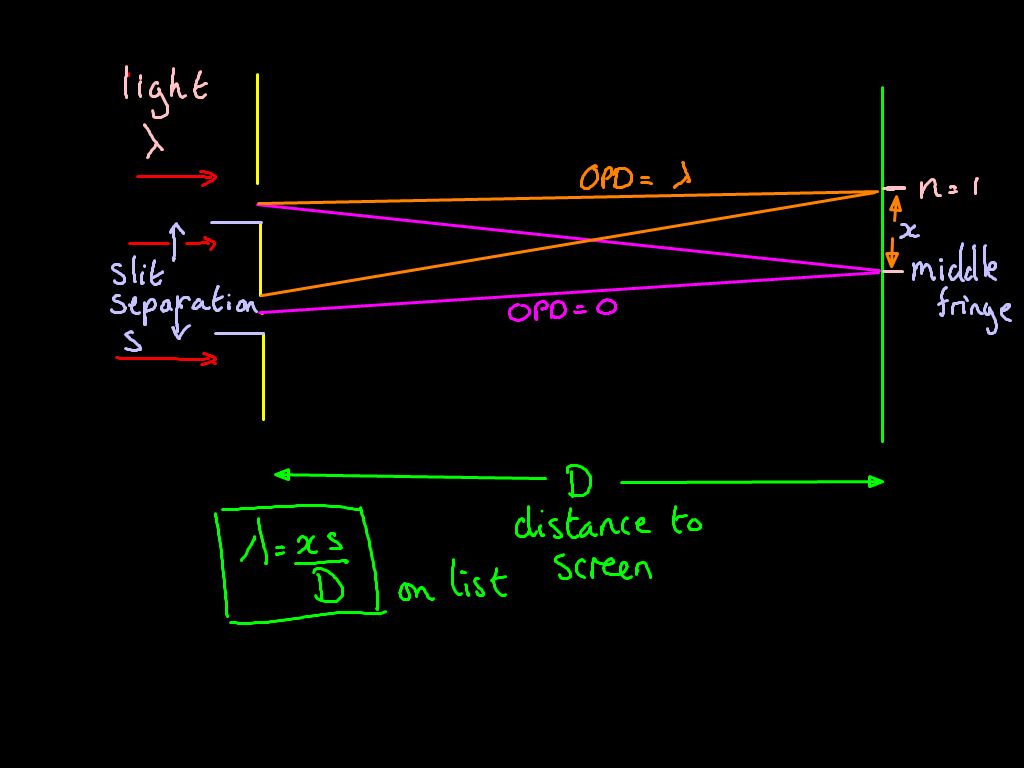
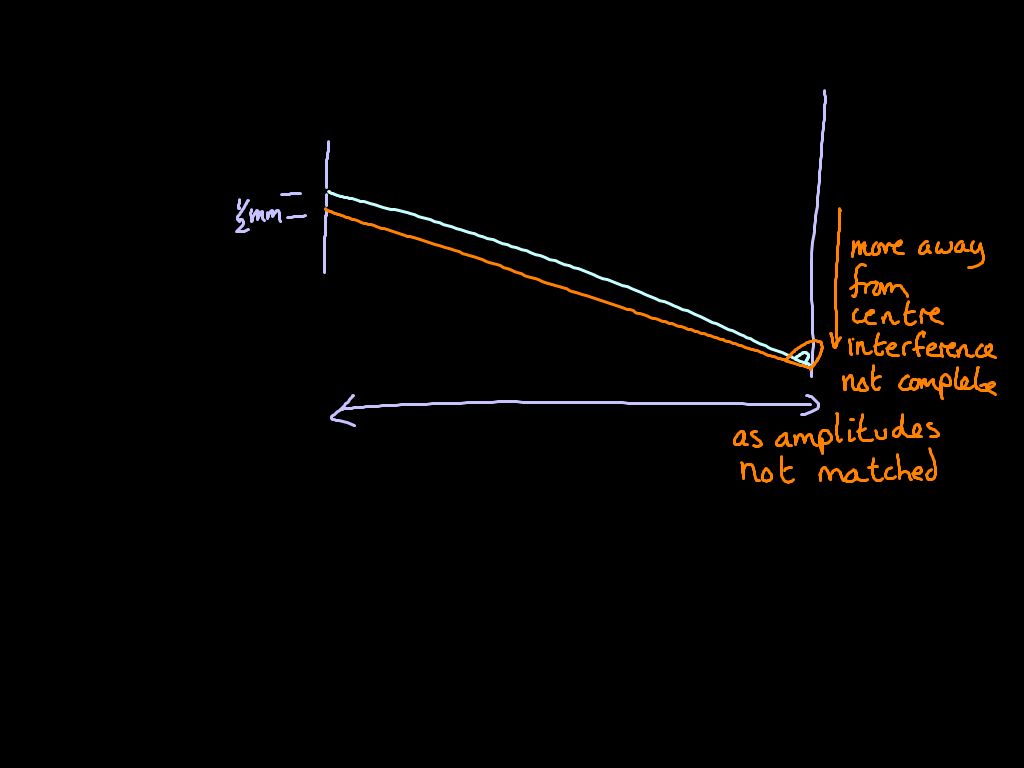
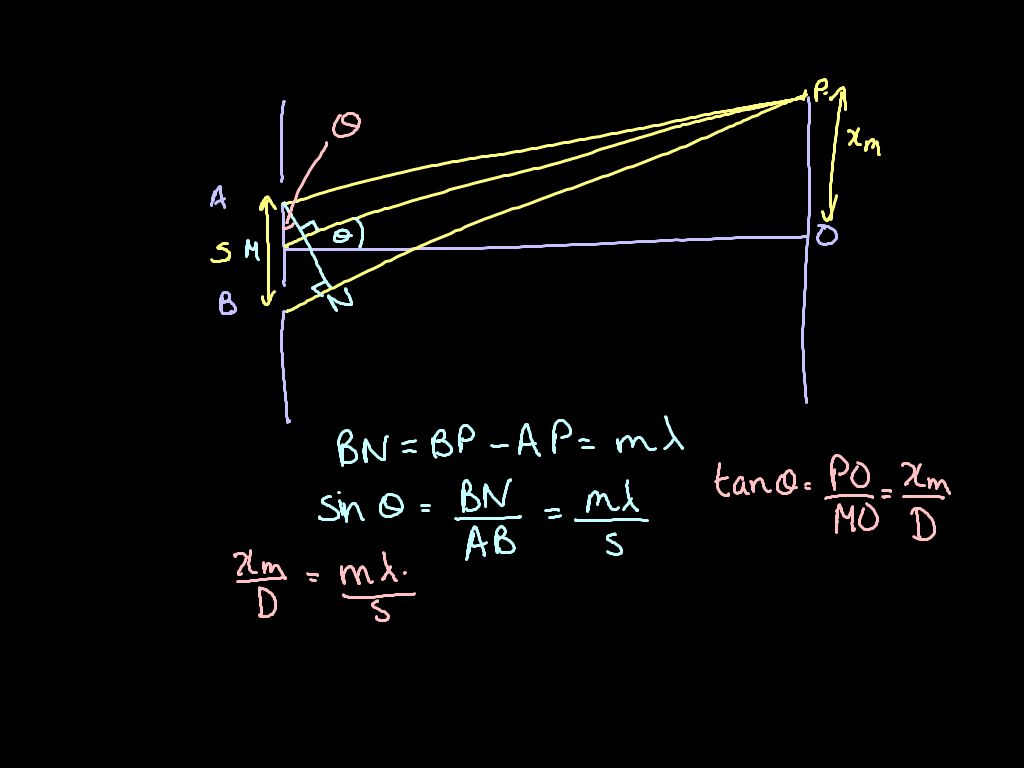
Monday, October 18, 2010

Tuesday, October 12, 2010

Thursday, October 07, 2010

Tuesday, October 05, 2010

Wednesday, September 15, 2010

Wednesday, September 08, 2010

Y12 Suffix

Wednesday, June 23, 2010

y13 Circular Motion


Some of this morning's work didn't save. I shall be repeating this lesson on Friday with the other group. I will publish the missing slides then.

Tuesday, June 22, 2010

Thursday, June 17, 2010

y12 shm

Tuesday, May 25, 2010

y13 Fields questions

Questions on Fields

1. (a) (i) Cp = 2 + 4 = 6 μF A1


(ii) 1/C = 1/2 + ¼ C1

Cs = 4/3 =1.33 μF A1

(b) (i) 6.0 V A1

(ii) Q = CpV C1

= 6 × 6 = 36 μC A1

(c) E = ½ CsV2 C1

= 24 × 10–6 A1

(d) (i) The capacitors discharge through the voltmeter. B1

(ii) V = V0e–t/CR

1/4 =e–t/(6×12) C1

ln 4 = t / 72 C1

t = 72 ln 4 ≈ 100 s A1

[12]


2. It is the force (of attraction) per unit mass. B1

[1]


3. (i) Suitable recognisable pattern around (not just between) the charges B1

Quality mark: symmetry, spacing, lines joined to charges B1

Consistent arrows toward B on some lines B1

(ii) Use of E = (1/4πε0)Q/r2 C1

Sum of two equal terms

E = 2 × 9 × 109 × 1.6 × 10–19 / (2.0 × 10⁻¹⁰)2 C1

E = 7.2 × 10¹⁰ N C–1 or V m–1 A1

(iii) The separation between the ions because this has an effect on the

breaking force. (Allow the size of ionic ‘charges’) B1

[7]


4. (i) The gravitational field strength g is not constant. B1

The student’s value would be greater than the actual value (because the

average magnitude of g is less than 9.81 m s–1). B1

(ii) KE = 1/2 mv2

v = 2πr / T C1

v = 2 × π × (6800 + 6400) × 103 / 8.5 × 10³ / v = 9.76 × 10³ (m s–1) C1

KE = 1/2 × 1500 × (9.76 × 103)2

KE = 7.1(4) × 1010 (J) A1


(iii) A geostationary satellite stays above the same point on the Earth and as B1

such can be used for radio communications. (the term communications to M1

be included and spelled correctly to gain the mark). A1

The satellite is not in geostationary orbit

because its period is less than 1 day / 8.6 × 10⁴ s.

[8]


5. (a) forces FS and FG acting inwards, force FE acting outwards - all through

centre of proton;

3 forces 2/2, 2 forces 1/2, marked and labelled (2) 2

(b) FE = FS + FG;

accept FE + FS + FG = 0 allow ecf from (a) (1) 1

(c) (i) FE = Q2 / (4π ε0 r2) (1)

= (1.6 × 10⁻¹⁹)2 / [4π × 8.85 × 10–12 (2.8 × 10⁻¹⁵)2] = 29 N (1)

use of r = 1.4 × 10⁻¹⁵ m (–1) once only 2

(ii) FG = m2 G / r2 (1)

= (1.67 × 10⁻²⁷)2 × 6.67 × 10–11 / (2.8 × 10⁻¹⁵)2 = 2.4 × 10⁻³⁵ N (1) 2

(iii) FS = 29 N / same as FE allow ecf (1) 1

(d) FE >> FG so FG negligible / insignificant / can be ignored or AW (1) 1

(e) (i) FE = 0 (1) 1

(ii) FG = 2.4 × 10⁻³⁵ N (approx.) allow ecf (1) 1

(iii) FS = 2.4 × 10⁻³⁵ N (approx.) (1)

comment: FS now repulsive (not attractive) or AW

or indicated by minus sign with FS; (1) any 3 1

[12]


6. (i) r has been increased by a factor of 3 from the centre of planet. C1

g = (40/32 =) 4.4(4) (N kg–1) A1

(ii) M = gr2 / G

M = (40 × [2.0 × 107]2) / 6.67 × 10⁻¹¹ C1

M = 2.4 × 1026 (kg) A1

(iii) M = ρV = 4/3 πr3 ρ M1

g = GM / r2 r3 / r2 (Hence g r) A1

[6]


7. The astronaut is accelerating / has centripetal acceleration (1)

and the space station has the same acceleration (1)

a person does not feel gravity (1)

only feels forces applied by contact with the walls of the space station (1)

no support force from the space station (as they have the same acceleration) (1) 4

MAXIMUM (4)

[4]

Monday, May 24, 2010

y13 Momentum questions

1. The (net) force acting on an object is (directly) proportional to the rate of


change of momentum and takes place in the direction of the force. B2

[2]


2. According to Newton’s third law: When two objects interact, the force

acting on one of objects is equal but opposite to the force acting on the

other object. B1

The time t of ‘contact’ for the objects is the same and since Δp = Ft , B1

the gain in momentum for one object is equal to the loss of momentum for

the other object. B1

[3]


3. (i) u = 32 (m s–1) v = –2/3 × 32 = –21.33 (m s–1) t = 0.50 s C1

Δp = 800(–21.33 – 32) = –4.27 × 10⁴ kg m s–1 A1

(ii) F = Δp / Δt = / F = 4.27 × 10⁴ / 0.50 C1

F ≈ 8.5 × 10⁴ (N) A1

Direction: Opposite to the initial velocity / away from the wall B1

(iii) N = pV / kT = (1.0 × 105 × 3.4 × 10–2) / (1.38 × 10–23 × 293) C1

N = 8.41 × 10²³ C1

mass = 8.41 × 10²³ / 6.02 × 1023) × 0.014

mass = 0.0196 (kg) ≈ 0.020 kg A1

[8]


4. (a) (i) to come to rest simultaneously, total mtm. = 0 or AW (1) 1

(but initial mtm. not zero)

(ii) initial mtm. = 3 m u – 2 m u = m u (1)

when closest, mtm. = (3m + 2m) v (1) 2

so 5m v = m u (and v = u / 5)

(b) (i) initial k.e. = final k.e. + (gain of) p.e. (1) 1

(ii) k.e. = ½ m v2 (1)

total k.e. = ½ × 3 m u2 + ½ × 2 m u2 (= 2.5 m u2) (1)

= 2.5 × 1.67 × 10–27 u2 (= 4.18 × 10⁻²⁷ u2) (1) 3

allow m = 1.66 × 10⁻²⁷ kg for full credit

(iii) gain of p.e. = initial k.e. – final k.e.

= 4.18 × 10⁻²⁷ u2 – 4.18 × 10⁻²⁷ (u/5)2 (2)

1.53 × 10–13 = 4.01 × 10⁻²⁷ u2 (1) algebra

u = 6.18 × 10⁶ m s–1 (1) 4

omits - 4.18 × 10⁻²⁷ (u/5)2, gets u = 6. 06 × 106 m s–1: 1/2, 1, 1 = 3/4

[11]


5. (a) (i) Mass × velocity/mv with symbols defined 1

(ii) 0 = mAvA ± mBvB or mAvA = mBvB (1)

vA/vB = ± mB/mA (1) 2

max 1 mark for final expression without line 1

(b) (i) vA = (10/5 =) 2.0 (m s–1) and vB = (10/10 =) 1.0 (m s–1) 1

(ii) t1 = 3.0/2.0 = 1.5 (s) ecf b(i) 1

(iii) x = 2.1 – 1.0 × 1.5 = 0.6 (m) 1

(iv) v = vB + (5/50)vA = 1.0 + 0.2 (= 1.2 m s–1) 1

(v) t2 = t1 + 0.6/1.2 = 2.0 (s) 1

(vi) At collision the container (and fragments) stop (1)

By conservation of momentum, total momentum is still zero/AW (1) 2

(vii) straight lines from (0,0) to (1.5,0); (1.5,0) to (2.0,0.1); (x,0.1) for all x>2 3

[13]


6. (a) (i) 3.8 ± 0.3 (N s) 1

(ii) momentum (of the ball) accept impulse 1

(iii) mv = 3.8 or v = 3.8/0.16; = 23 (m s–1) ecf a 2

(iv) use F = ma giving 24 = 0.16a; a = 150 (m s–2) 2

(b) (i) exponential 1

(ii) e.g. h1/h2 = ek = 2.1(5); giving k = 0.74 to 0.76

or substitution from a line of table; gives 0.748, 0.757 or 0.746 2

(iii) 1.5 (m) 1

(iv) ∆k.e. = mg∆h; = 0.16 × 9.8 × 0.38 (= 0.60 J) 2

[12]

Wednesday, May 19, 2010

y13 Questions on magnetism and Universe

y13 Questions on magnetism and Universe

1. (a) B = F/Il with symbols explained or appropriate statement in words; (1)


explicit reference to I and B at right angles/define from F = BQv etc (1) 2

(b) (i) arrow towards centre of circle 1

(ii) field out of paper; Fleming’s L.H. rule/moving protons act as

conventional current 2

(iii) F = Bev allow BQv 1

(iv) F = mv2/r; Bev = mv2/r; (2)

B = mv/er = 1.67 × 10–27 × 1.5 × 107/(1.6 × 10–19 × 60); = 0.0026; T (3) 5

allow Wb m–2

(v) the field must be doubled; (1)

B ∞ v (as m, e and r are fixed)/an increased force is required

to maintain the same radius (1) 2

[13]


2. At least 3 field lines inside solenoid parallel to axis; (1)

Lines equally spaced over some of length of solenoid. (1)

Arrows on lines pointing left to right. (1) 3

[3]


3. (a) Positive as E-field is downwards/top plate is positive/like charges repel/AW (1) 1

(b) (i) k.e. = QV; = 300 × 1.6 × 10–19 = (4.8 × 10⁻¹⁷ J) (2) 2

(ii) 1/2mv2 = 4.8 × 10⁻¹⁷; = 0.5 × 2.3 × 10–26 × v2 so v2 = 4.17 × 10⁹;

(giving v = 6.46 × 10⁴ m s–1) (2) 2

(c) E = V/d; so d = V/E = 600/4 × 104 = 0.015 m (2) 2

(d) (i) semicircle to right of hole (1) ecf(a); (a) and d(i) to be consistent 1

(ii) mv2/r; = BQv; (2)

giving r = mv/BQ = 2.3 × 10–26 × 6.5 × 104/(0.17 × 1.6 × 10–19); (1)

r = 55 mm;so distance = 2r = 0.11 m (2) 5

[13]


4. Any four from:

Uniform intensity in all directions / everywhere

Structure in background intensity / ripples

Produced when matter and radiation decoupled

Originally gamma radiation

(gamma) red-shifted to microwave / originally higher energy

Evidence that universe began with big bang

Temperature corresponds to 2.7 K / 3K / that predicted by big bang model B1 × 4

Link between evidence and explanation. (1)

[5]


5. Any 5 from

red shift data for galaxies (accept stars) 1

calculate velocity from red shift 1

galaxies/ stars receding from Earth 1

distance data for galaxies/ stars 1

velocity α distance / v/r = constant / v-r graph straight line 1

universe began at a single point 1

[5]


6. (a) Any two

stars rotate around galactic centre 1

star with velocity component towards Earth 1

reference to motion/shape of galaxy 1

or other valid points eg blue shift

(b) Ho = 75/ 3 × 10¹⁹ s–1 1

t ≈ 1/ 2.5 × 10⁻¹⁸ 1

t ≈ 4 × 10¹⁷ s 1

[5]

Friday, May 14, 2010

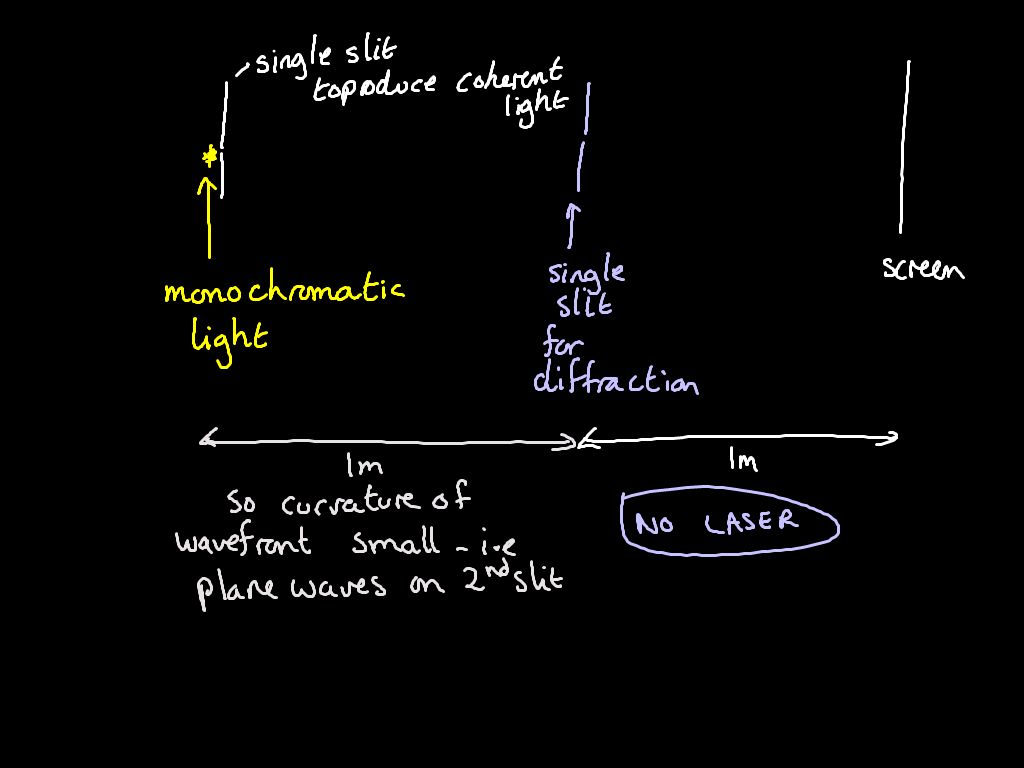
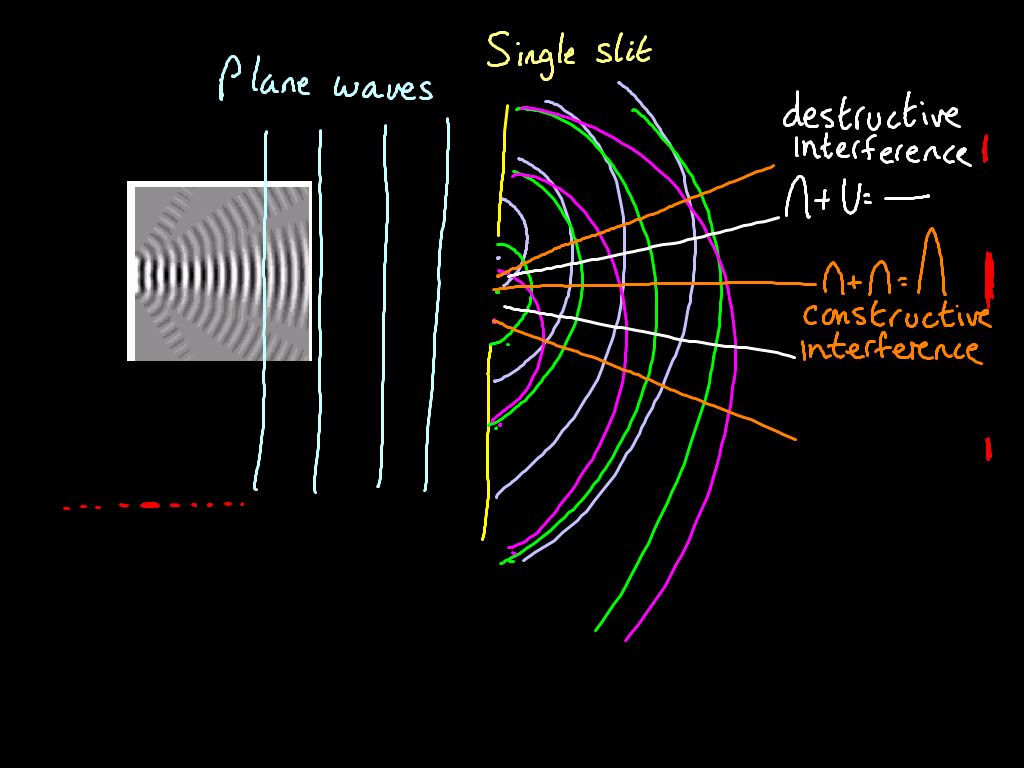
y12 diffraction

y12 diffraction

y12 diffraction

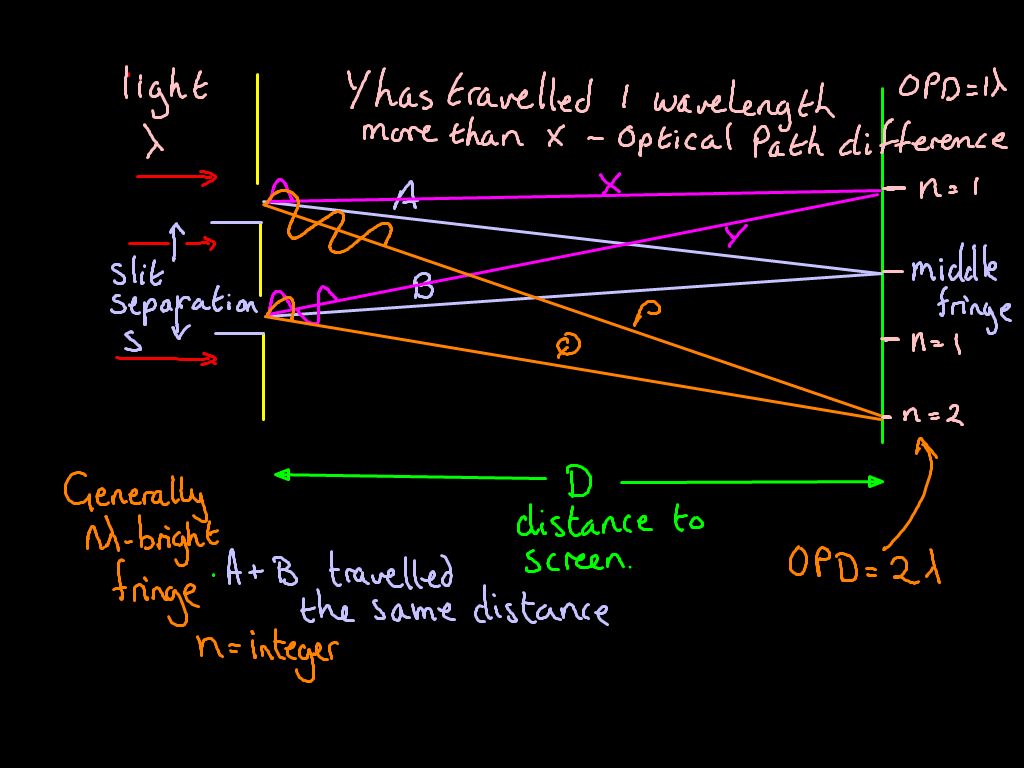
y12 Youngs


y12 Waves

Qustions on waves

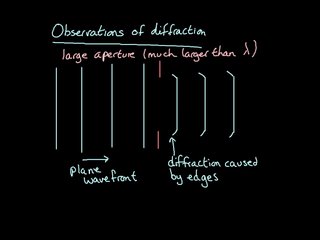
1. circular arcs (penalise anything flat) B1


same constant wavelength before and after gap – judged by eye or labelled B1

this means at least 3 wavefronts need to be drawn

[2]


2. for noticeable diffraction  gap size (WTTE) B1

 for sound much bigger than for light (WTTE) B1

[2]


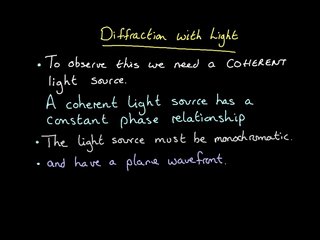
3. (i) wave sources that have a constant phase difference (WTTE) B2

{max of 1 mark for sources have same frequency/wavelength/in phase C1}

(ii) sum of displacements (= resultant displacement) (WTTE) B1

(no marks for reference to amplitude)

[3]


4. (a) (i) constant phase difference

(allow 1 mark for same phase difference or same frequency/wavelength) B2

(ii) path difference = λ/2 B1

(b) (i) evidence shown that fringe width x = 8.0 mm B1

a = λD/x = 6.4 × 10–7 × 1.5/8.0 × 10–3 = 1.2 × 10⁻⁴ m C1

(give 2 marks for using x = 4.0 mm giving a = 2.4 × 10⁻⁴ m) A1

(ii) maximum intensity when y = 0 AND minima at +4 and –4 B1

correct repeat distance, i.e. 8.0 mm with at least 2 full cycles drawn B1

[8]


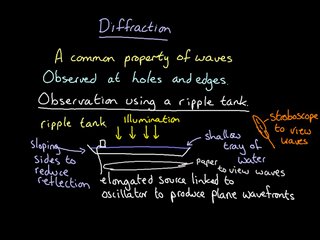
5. (i) semicircular wavefronts leaving the gap B1

no change in wavelength stated OR

clearly shown (at least 3 waves needed) – judged by eye B1

(ii) LESS diffraction would occur – shown or stated B1

wavefronts mainly plane (by eye) (allow curved at edges) B1

(iii) MORE diffraction for SOUND B1

Wavelength of sound > wavelength of light (WTTE) B1

Valid comparison of wavelength of light or sound with doorway e.g.

doorway of similar size to wavelength of sound OR

wavelength of light is very small compared to door (WTTE) B1

[7]


6. (i) 1. path diff. = n (where n = 0,1,2 etc) {allow 0, OR , OR 2 etc} B1

2. path diff = (n  ½) (where n = 0,1,etc) {allow = 0.5 OR,1.5, etc} B1

{do not allow answers purely about phase diff. e.g. with degrees or

 used and no ref to }

(ii) recall of formula  = ax/D C1

correct substitution for a,  and D: e.g.  = (4.86  10–7  2)/0.5  10–3 C1

x = 1.94  10–3 m (1.9 or 1.944) A1

(iii) central white fringe B1

other fringes are coloured (WTTE: e.g. allow spectrum formed) B1

[7]


7. diagram showing

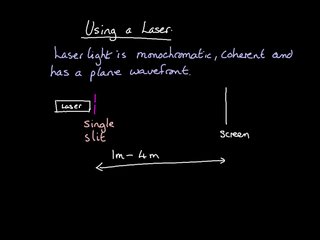
laser/light source placed directly behind double slit AND screen placed

in front of slits B1

{single slit NOT required; no labelling required}

(i) D: allow any value between 30cm and 10m B1

(ii) a: allow any value between 0.1mm and 2mm B1

[3]


8. (a) (i) evidence of good practice: i.e distance for nx measured e.g.

5x = 18mm C1

x = 3.6 mm (OR 3.5 OR 3.7) A1

{x = 3.4, 3.8, 3.9, 4.0, or 4 mm, implying  is directly

measured, and score 1 mark)

(ii) for O path difference = 0 B1

for A path difference = 3() B1

for B path difference = 1.5() B1

(b) recall of = ax/D OR  =D/a OR    B1

 is smaller for blue light (than red light) hence  is SMALLER (WTTE) B1

[7]


9. Maximum of 2 marks for correctly identifying the 4 errors OR stating the 2

correct notes:

i.e. errors in notes 1, 2, 3, and 6 (shown anywhere) B2

{5 or 6 or 2 or 1 notes nominated scores ZERO, 4 correct scores 2, 3 correct scores 1}

Valid corrections score 1 mark each: do not allow “NOT” corrections apart

from note 3

Note 1: In longitudinal waves vibrations are parallel to wave direction (WTTE) B1

{OR in transverse waves vibrations are perpendicular to wave

direction (WTTE}

Note 2 light (or any of the em waves) can travel through a vacuum (WTTE) B1

{allow sound/longitudinal waves cannot travel thro’ a vacuum}

Note 3: waves carry energy/disturbance (not displacement or info)

from…. (WTTE) B1

{allow “waves do not carry the medium” and “the medium carries

the waves from…….”}

Note 6: wavelength = distance from crest to crest/trough to trough/max

to max (WTTE) B1

[6]

Thursday, May 13, 2010

y12 questions on moments

Questions on moments


1. (i) pressure = force / area B1


(ii) moment = force multiplied by the perpendicular distance


(from the line of action of the force) to the pivot B1


[2]


2. (a) The net force acting on the object must be zero B1


The net moment (about any point) must also be zero B1


(b) Taking moments about A, we have


Sum of clockwise moments = sum of anticlockwise moments C1


(0.25 × 200) + (5.0 × 9.81 × 0.4) = 0.8F C1


F = 87 (N) A1


(c) These forces are opposite but not equal in magnitude. B1


[6]


3. (i) Moment is the force  the perpendicular distance


from (the line of action of) the force to the pivot/point


(missing perpendicular 1, missing from the force to B2


the pivot / point 1)


(ii) Torque of a couple: one of the forces x B1


perpendicular distance between (the lines of action of) the forces


[3]


4. (i) 1 3600  1.0 = X  2.5 C2


one mark for one correct moment, one mark for the


second correct moment and equated to first moment A0


2 X = 1440 (N) C1


Y = 3600 – 1440 or 3600  1.5 = Y  2.5 A1


= 2160 (N) B1


(ii) Not a couple as forces are not equal B1


and not in opposite directions / the forces are in the


same direction C1


(iii) P = F / A B1


= 1440 / 2.3  10–2 B1


= 62609 (6.3  104)


unit Pa or N m–2


[9]


5. (i) 1 The (distribution of the) mass of the lawn mower is


not uniform B1


2. One correct moment about A stated


B  110 or 350  20 B1


B = (350  20) / 110 (moments equated) B1


B = 63.6 (N) A0


3. A = 350  63.6 = 286(.4) (N) A1


(ii) A goes down and B goes up B1


Turning effect of B is less / B needs greater force to


produce the same moment / if distance goes down


force needs to go up (to maintain the same turning effect) B1


[6]


6. (a) (i) • F × 25 sin15 / F × 0.25 sin 15 for one moment. (1)


• 450 × 40 cos 30 / 450 × 0.4 cos 30 for the other moment. (1)


• moments equated or stated, even if not correct.


[Do not accept forces resolved vertically] (1)


• Answer F = 2409 (N). (1) 4


(ii) • Answer F = 951 (N). 1


(b) • Link large force (2409N) with small angle (30°) /


The more nearly horizontal / the smaller the angle with the horizontal


your back is, the greater the force needed (from the muscles). (1)


• the force is large because the anti-clockwise moment is large (1)


• the anti-clockwise moment is large because the perpendicular


distance to the pivot is large. (1)


(First 3 points + any one of the following:) (1)


• consequence, eg tendon ‘goes’, etc.


• (Therefore) keep your back as vertical / upright as possible,


• … with the load close to your body …


• … and bend your knees / use leg muscles to do some of the lifting.


• ..back is strong in compression / weak in shear, etc. 4


[9]


7. (a) (i) force drawn vertically upwards at plunger B1


force drawn vertically at H B1


(ii) 20  500 / force on Plunger  120 (one correct moment stated) B1


Plunger force  120 = (20  500) B1


Plunger force = 83(.3) (N) A0


(b) (i) pressure = force / area


= 83 / 4  10–3 C1


= 20800 (Pa) A1


(ii) decrease area of plunger / decrease distance H to plunger /


increase F / increase length of arm B2


MAX 2


[8]


8. (i) W vertically down at G B1


Force at O vertical B1


(ii) V × 0.9 × cos60 = W × 0.35 × cos60 B1


V = (25 × 0.35) / 0.9 B1


= 9.7(22) (N) A0


(iii) total force is zero stated or implied / 25 – 9.7 C1


force at hinge = 15.3 (N) A1


(or may take moments about G or V)


[6]


Wednesday, May 12, 2010

Y12 Photons

Y12 Questions on Photons

1. 3.9 eV = 3.9 × 1.6 × 10–19 J (= 6.24 × 10⁻¹⁹ J) (1)


λ = hc/E = 6.63 × 10–34 × 3.0 × 108 / 3.9 × 1.6 × 10–19 (= 320 × 10–9 m) (1) 2

[2]


2. (i) 1. E = hf / / f = 7.5  1017 (Hz) C1

(‘E = hf’ can be secured in (i))

/ E = 6.63  10–34  7.5  1017 C1

energy = 4.97  10–16 (J)  5.0  10–16 (J) (Allow 1 sf answer here) A1

2. (Possible ecf)

energy = 3.1  103 (eV) B1

(ii) The answer to (c)(i)1. and 1.4 (W) are used to determine the rate

of photons C1

(Possible ecf) C1

number = 2.8  1015 (s–1) (If 3100 eV is used, then allow 2/3 for 4.5  10–4) A1

[7]


3. (Allow any subject) C1

C1

v = 1.43  103  1.4  103 (ms–1) A1

[3]


4. (i) Visible (light) B1

(ii) work function = 1.9  1.6  10–19 M1

work function = 3.04  10–19 (J)  3.0  10–19 (J) A0


(iii) 1. E = hf / C1

E =

E = 3.9  10–19 (J) A1

2. hf =  + KE(max) / hf =  + ½ mv2

(Allow E =  + ½ mv2 if E is qualified in (iii)1.) C1

3.9  10–19 = 3.0  10–19 + KE(max) / 3.9  10–19 = 3.04  10–19 + KE(max) C1

KE = 9.0  10–20 (J) / KE = 8.6  10–20 (J) (Possible ecf) A1

(iv) No change (to maximum KE of electron) B1

Each photon has same energy (but there are fewer photons) B1

(v) number of photons = ( 2.05  1017) (Possible ecf) C1

number of electrons = 0.07 

number of electrons = 1.44  1016 (s–1)  1.4 × 10¹⁶ (s–1) A1

[11]


5.


(Four correct: 3 marks, three correct: 2 marks, two correct: 1 mark) B3

[3]


6. (i) particle / particulate / quantum / photon B1

(ii) wave B1

[2]


7. Maximum of three from points 1 to 6: B1  3

1. Photon mentioned (e.g.: photons interact with the surface electrons)

2. Energy is conserved (between the photon and the electron / in the interaction)

3. hf =   KE(max)

4. A single photon interacts with a single electron / It is a one-to-one interaction

5. Electron is removed when photon energy is greater than / equal to the

work function

(energy) /  (Allow ora)

6. Electron removed when frequency is greater than / equal to the threshold

frequency (Allow ora)

7. (Visible) light has lower frequency than the threshold frequency / Energy of

(visible) light photon is less than the work function (energy) (ora with uv) B1

8. Greater intensity of (visible) light means more photons (per unit time) /

energy of a photon remains the same B1

QWC Spelling, punctuation and grammar B1

Organisation B1

[7]


8. (a) quantum of energy / radiation / packet of energy B1

(b) (i) f = E/h = 5.60 × 10⁻¹⁹ /6.63 × 10–34 C1

f = 8.45 × 10¹⁴ (Hz) A1

(ii) 1 minimum energy to release an electron from the surface (of the metal) B1

2 5.60 × 10⁻¹⁹ – 4.80 × 10⁻¹⁹ ( = 8.0 × 10⁻²⁰ J) B1

(iii) 8.0 × 10–20 = ½(9.1 × 10⁻³¹)v2 M1

giving v = 4.2 × 10⁵ (m s–1) A1

(c) (i) Correct selection of: λ = h/p or λ = h/mv M1

where all symbols are defined A1

(ii) λ = 6.6 × 10⁻³⁴ /(9.1 × 10–31 × 4.2 × 105) C1

λ = 1.7 × 10⁻⁹ (m) A1

[11]


9. (a) one (or more) electrons removed (or added) to an atom 1

(b) E = hf = hc/λ together with knowledge of symbol meaning (1)

= (1)

= 8.36 × 10⁻¹⁹ (J) (1) 3

(c) frequency of UV is greater than frequency of light

OR alternative statement in terms of wavelength.

so photon energy of visible light is less than photon energy of UV (1)

PLUS one of the idea of conservation of energy

it is not possible for a low energy photon to give a high energy photon

this is a one to one process (1) 2


(d) E = V/d and power of 10 correct for d (1)

= 30/0.00020 = 150 000 (1)

V m–1 (1) 3

[9]


10. (a) Maximum of five marks

Up to four from:

/ M1

All symbols (, h, m and v or p) defined A1

Electrons travel / move / propagate (through space) as a wave B1

Electrons are diffracted / ‘spread out’ M1

by the atoms / spacing between the atoms A1

The electrons are diffracted when their wavelength is less than or

comparable or same as size of atoms / gap between the atoms B1

Up to two from:

When the speed of electrons is increased) the rings ‘get smaller’ B1

(At greater speed of electrons) the wavelength is shorter B1

(At greater speed of electrons) there is less diffraction B1

QWC Organisation B1

Spelling, punctuation & grammar B1

(b) Electrons have mass / momentum / charge / can be ‘accelerated’ B1

[8]


11. (i) The minimum frequency needed to free an electron

(from the surface of a metal) B1

(ii)1 Line extended intersects (the f axis at) this value / At this frequency, Ek = 0 B1

(ii)2 ( = ) h  5.0  1014 / ( = ) 6.63  10–34  5.0  1014 C1

work function energy = 3.3  10–19 J A1

(iii)1 1 The gradient / slope of the line is the same B1

The gradient is equal to h / independent of the metal B1

(iii)2 The line is shifted to the right B1

The threshold frequency is greater (AW) B1

[8]


12. (a) Any five from: B1 × 5

1. Photoelectric (effect) mentioned

2. Photon(s) mentioned in correct context / E = hf

3. One-to-one ‘interaction’ between photon & electron

4. Surface electrons are involved

5. Electron released / photoelectric (effect) when photon

energy > / = work function (energy)

6. Electrons emitted / photoelectric (effect) when

frequency > / = threshold frequency

7. Energy is conserved (in the ‘interaction’ between photon and electron)

8. Reference to Einstein’s equation: hf =  + KE(max)

[QWC: Spelling and Grammar]

(b) (i) 1. (energy of photon = 2.2 + 0.3) B1

2.5 (eV) B1

2. (energy =) 2.5  1.6 10–19 (Possible ecf from (b)(i)1.) C1

4.0  10–19 (J) (Allow 1 sf answer) A1

(ii) (f =) (Possible ecf) C1

(f = )

(f =) 6.03  1014  6.0  1014 (Hz) (Allow 6  1014) A1

(c) Each photon has more energy / There are fewer photons (in B1

a given time because intensity is the same)

Smaller current B1

[13]


13. (i) 1. The minimum frequency (of radiation \ waves) needed for electrons

to be released (from the metal surface) \ for photoelectric effect B1

2. Its temperature increases \ gets warm \ ‘heats up’ B1

(ii) E = 2.2  1.9 (= 4.1) C1

E = 4.1  1.6  10–19 = 6.56  10–19(J) C1

(Allow this mark for correct conversion of either 1.9 eV or 2.2 eV to joules)

C1

 = 3.03  10–7  3.0  10–7(m)

(Allow 1 sf answer) A1

(Allow 3/4 marks for  = 4.85  10–26 m when eV is not converted to joules)

[6]

Tuesday, May 11, 2010

Y13 Stars

Questions on Stars

1. any 4 from:


end of H burning/red giant/supergiant (1)

onset of He fusion/fusion of heavier nuclei (1)

gravitational collapse of core (1)

supernova explosion/ star explodes (1)

suitable mass limit (chanderasekha limit 1.4M) (1)

supported against gavity by neutron gas pressure/ ref to

Fermi pressure (1)

internal structure protons and electrons combined/ very

thin atmosphere/ metallic crust (1) 4

[4]


2. Any 5 from

red shift data for galaxies (accept stars) 1

calculate velocity from red shift 1

galaxies/ stars receding from Earth 1

distance data for galaxies/ stars 1

velocity α distance / v/r = constant / v-r graph straight line 1

universe began at a single point 1

[5]


3. (a) Any two

stars rotate around galactic centre 1

star with velocity component towards Earth 1

reference to motion/shape of galaxy 1

or other valid points eg blue shift

(b) Ho = 75/ 3 × 10¹⁹ s–1 1

t ≈ 1/ 2.5 × 10⁻¹⁸ 1

t ≈ 4 × 10¹⁷ s 1

[5]


4. Hydrogen atoms/particles (1)

Collapse under gravity/ decrease of gpe (1)

Increase in kinetic energy/ temperature (1)

Fusion of protons (1)

Energy released/ ref. to E = ∆mc2 (1)

[5]


5. Any 6 from

Nuclear/hydrogen burning ends (1)

Mass > Chandrasekhar limit (1)

Expanding gas/planetary nebular/red giant (1)

Gravitational collapse /ref. to burning He or higher metals (1)

Correct ref. to (Fermi) pressure/ radiation pressure (1)

(must have ref. to pressure or force from radiation.)

Neutron star (neutron by itself, not enough) (1)

Correct reference to Schwarzschild radius/

allow mass> 3M/ allow ref. critical radius (1)

Black Hole (1) 6

[6]
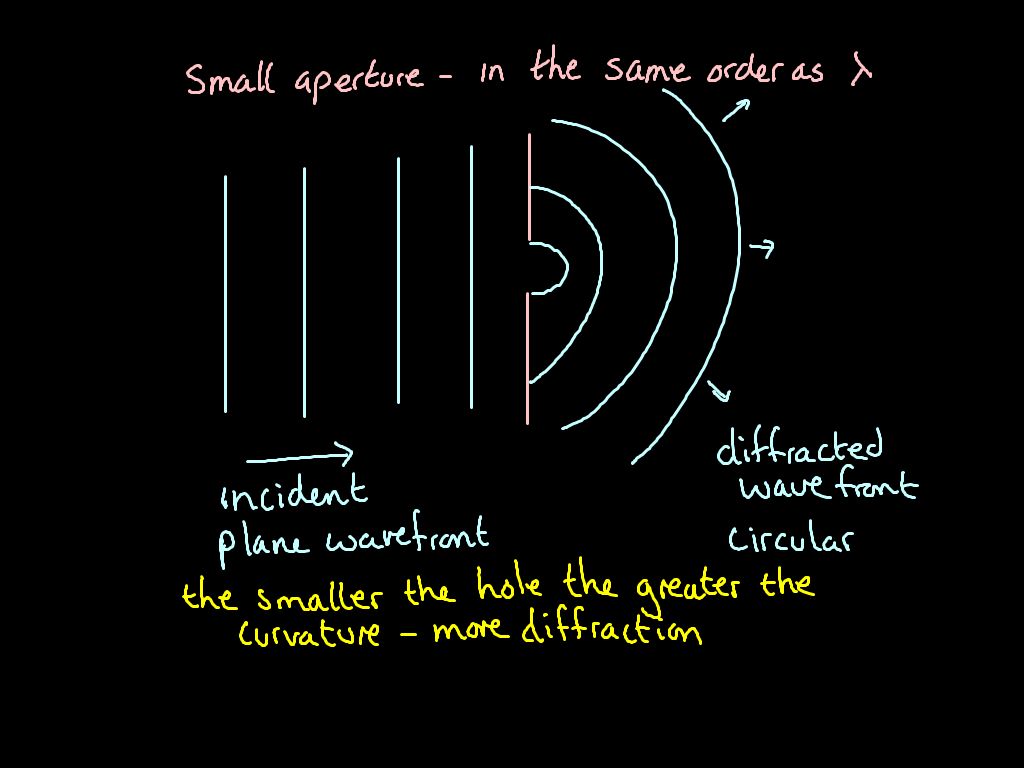


6. Ho2 = (1 × 10–26 × 8 × π × 6.67 × 10⁻¹¹) / 3 C1

Ho = 2.36 × 10⁻¹⁸ s–1 A1

[2]


7. (i) v/c = ∆λ / λ (1)

∆λ = 656.3 × 10–9 × 6.1 / 3 × 10⁸ (ignore minus sign) (1)

∆λ = 1.33 × 10⁻¹⁴ m (1) 3

(ii) Graph: any 4 points plotted correctly (1)

all correct (1) 2

(iii) graph: draw curve, reasonable attempt (1) 1

(iv) Either point where star moves perpendicular to line of sight (1) 1

(v) time = 72 h ± (1)h (ecf read value from their graph ± 1 h) (1) 1

(vi) r = 3√(6.7 × 10–11 × 4 × 1030 × [72 × 3600]2/ 4π2) ecf (1)

r = 7.70 × 10⁹ m ecf . (1) 2

(use of t = 72h 1/2)

[10]