Friday, October 17, 2014

Friday, October 10, 2014

Personal power Y12


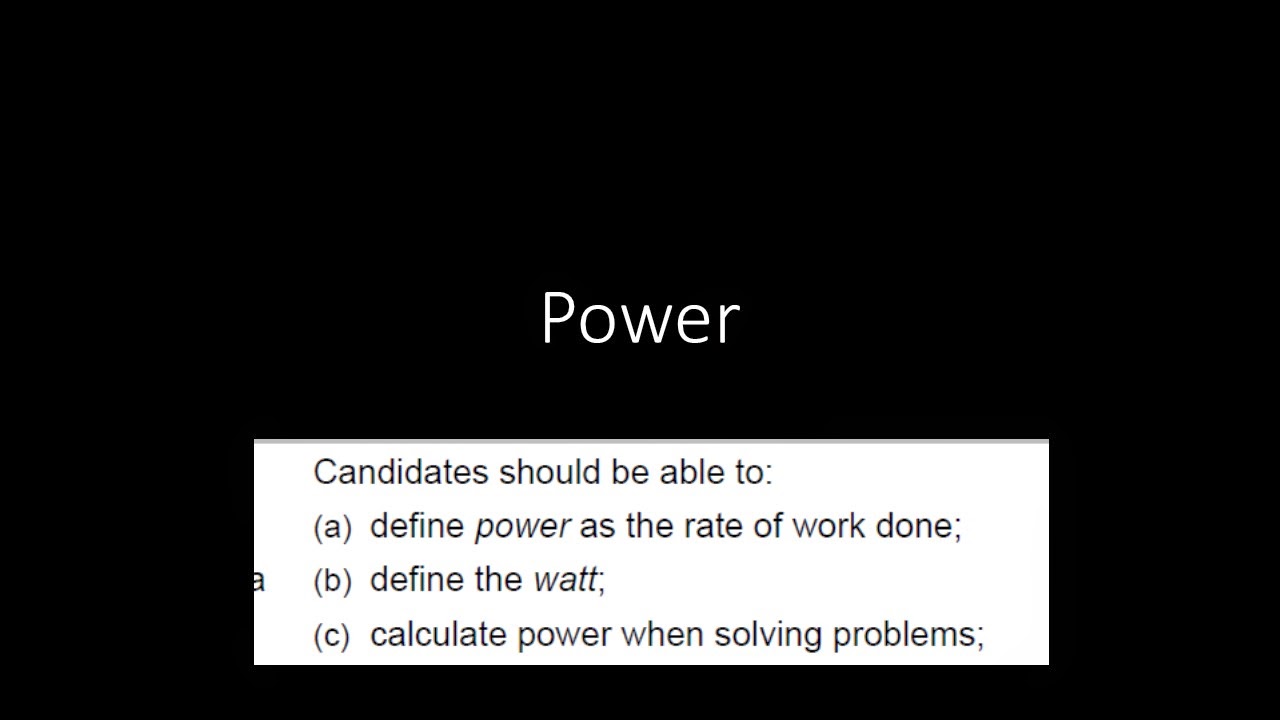
Power

(Use    g = 9.8 Nkg-1)
Examples
A         Find the work done in lifting a mass of 6 kg through a height of 10 m.
            W = Fx            W        work done in J
 F         force in N
x          distance moved in the direction of the force in m
W = 6 x 9.8 x 10
    = 588 J
B) An escalator carries 100 people of average mass 70 kg to a height of 6 m in one minute.
Find the power necessary to do this.
Work done = F x = 100 x (70 x 9.8) x 6 J
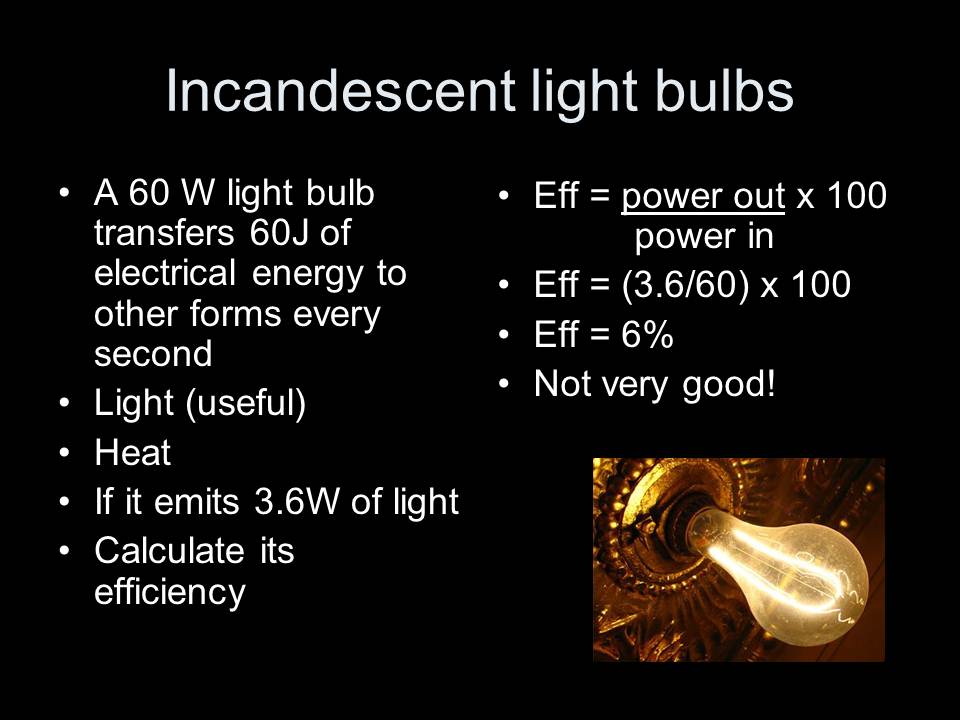
Power = rate of doing work = work done per second
           = (100 x 70 x 9.8 x 6) / 60 s = 6860 W or 6.86 kW
  1. Find the work done to lift a mass of 10 kg through a height of 5 m. If this takes 15 s what is the power?
  1. A mass of 5 kg is pulled along a surface at a constant speed. Frictional force between the mass and the surface is 4N what work is done in moving the mass 2 m along the surface? Find the power if this takes 2 s.
  1. A girl of mass 50 kg runs up a flight of steps 4.5 m high in 5 s. What power does she develop?
  1. 2000000 kg of water per second flow over a large waterfall of height 50 m. What power is available?
  1. The first-stage rocket motors of the Saturn 5 moon rocket burnt fuel at the rate of 13600 kg per second. The work done by the pumps to drive the fuel into the combustion chambers was the same as that necessary to lift the fuel through 1680 m. What power is needed to do this? (Your answer is about twice the engine power of the largest ocean liner.)
  1. A gas turbine locomotive developing 6330 kW pulls a train at a steady velocity of 108 kmh- 1. What is the total force in Newtons resisting the motion?
  1. A mechanical loader driven by an engine developing 3 kW lifts a total load of 200000 kg to a height of 3 m in one hour. What is the work done on the load? How much power is developed lifting the load? How does this compare with the work done by the motor in the same time?

Wednesday, October 08, 2014

Tuesday, September 30, 2014

Wednesday, September 24, 2014

Friday, September 19, 2014

Pendulum Experiment

V-Shaped Pendulum Practical


·         You are provided with a V-shaped pendulum set up as shown in Figure 1.
·         Set the initial distance d to 10.0cm. Measure the effective length L. When the pendulum bob is displaced and released in the direction shown in figure 2, it oscillates provided the amplitude is small.
·         Make suitable measurements to determine accurately the time period T of the oscillations.
·         Change the distance d to 5.0cm. Measure the effective length L. Determine the time period T of the oscillations.
·         It is suggested that T2 is proportional to L. Show numerically whether or not your measurements support this suggestion within a tolerance of 10%.
·         Describe and explain your observations.
·         In a different experiment, a teacher whirls a bung on a string in a vertical circle.
1. Describe how the tension in the string changes during a complete rotation.
2. Describe how the force on the bung changes during a complete rotation.

Sample Results
d=10.0cm, L=0.604m, T=1.564s

d=5.0cm, L=0.606m, T=1.5681s

Motion in a Circle and Forces acting